
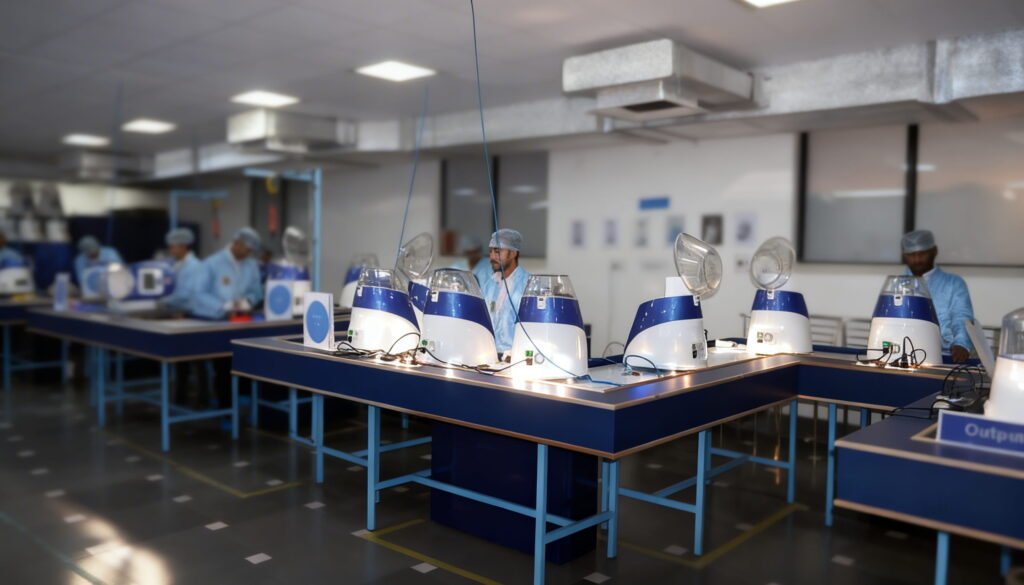
Multi-generation engineering and manufacturing optimization of a pre-analytical homogenization platform achieving ≤40-second lysis, clinical-grade reproducibility, and traceability aligned with global IVD and life sciences requirements.
Key Impact Metrics
- ≤40-second homogenization with tri-dimensional motion (5G generation)
- 5,500 RPM 3D motion for consistent and reproducible lysis
- 30% cost reduction through disciplined DFM and supply optimization
- 12,000+ units shipped with expansion from the US/EU into APAC
Client Overview
Geography: United States (serving US/EU with APAC expansion)
Company Type: IVD & Life Sciences Sample Preparation Platform Provider
Market Segment: Infectious Disease, Oncology (FFPE), Environmental & Forensic Laboratories
Device Classification: Pre-Analytical Homogenizer
Engagement Model: Multi-Generation Design & Lifecycle Partner (Gen 2–Gen 6)
The client aimed to deliver a pre-analytical platform capable of extracting DNA and RNA from challenging biological samples, while reducing manufacturing costs and aligning global regulatory documentation.
Business Challenge
Strategic Challenge
Standardize and scale a pre-analytical platform to accelerate time-to-result across infectious disease, oncology, and research workflows, maintaining performance and compliance.
Technical Challenge
Deliver controlled tri-dimensional high-speed motion with load balancing, shock mitigation, and thermal protection to preserve heat-sensitive analytes during intense, short-duration bead-beating cycles.
Regulatory & Compliance Challenge
Embed structured design controls (DHF/DMR), ISO 14971 risk management, and audit-ready traceability to align with IVDR pre-analytical validation expectations and international laboratory standards.
Manufacturing & Scale Challenge
Implement a scalable DFM architecture by standardizing components, simplifying assembly, and optimizing supplier relationships to reduce costs and support global volume demand.
Our Approach
Multi-Generation Engineering Evolution
From Gen 2 to Gen 6, we executed structured mechanical, firmware, and systems-level enhancements to improve performance, durability, and user experience.
Mechanical & Motion Architecture Optimization
- High-performance motor upgrades enabling >5,500 RPM tri-dimensional motion
- Advanced vibration-damping and load-balancing systems
- Fully sealed containment design to mitigate aerosol exposure
- Modular holder configurations supporting diverse throughput requirements
Thermal & Analytical Integrity Safeguards
- Rapid acceleration to target speed delivering ≤40-second homogenization
- Integrated Peltier cooling for RNA-sensitive workflows
- Structural and thermal management refinements for sustained operation
Human-Centered Interface & Data Integrity
- Evolution to guided touchscreen controls with programmable protocols
- Integrated data logging supporting laboratory audit trails
- Firmware lifecycle aligned with IEC 62304 principles.
Quality & Risk Integration
- Comprehensive DHF, DMR, and DHR traceability
- ISO 13485-aligned design control discipline
- ISO 14971 risk management embedded across lifecycle stages
Cost & Supply Chain Optimization
- Bill of Materials rationalization
- Assembly simplification and modularization
- Supplier leverage and procurement strategy
- 30% cost reduction achieved without compromising analytical performance
Results & Business Impact
Measurable Outcomes
- ≤40-second reproducible homogenization
- 5,500 RPM tri-dimensional motion consistency
- 30% reduction in unit cost
Operational Impact
Standardized automation reduced inter-operator variability. Sealed-tube containment improved biosafety and bench stability. High-throughput configurations enabled parallel sample processing with consistent results.
Regulatory Outcome
Structured design documentation, risk files, and traceability systems aligned with IVDR and ISO expectations for pre-analytical validation and audit readiness.
Market Outcome
Over 12,000 units deployed globally, expanding from the US and EU into APAC markets, supported by multi-generation lifecycle management and sustained field reliability.
Elevate Your Pre-Analytical Platform to a Global Standard
As a design-led CDMO partner, we integrate robust mechanical engineering, disciplined quality systems, and cost-optimized manufacturing to deliver accelerated lysis, increased yields, and scalable global deployment for IVD innovators.
