
Medical Device Contract Manufacturing Services
Syrma Johari MedTech delivers ISO 13485-aligned contract manufacturing structured for regulated environments. Manufacturing execution operates within global compliance frameworks to ensure validated production processes, end-to-end traceability, and long-term product continuity across global markets.





Design-Led Manufacturing Execution
Integrated Medical Device Manufacturing Capabilities
Precision Metal Components and Assemblies
CNC and VMC machining, sheet metal fabrication, stamping, die casting, metal injection molding (MIM), aluminum extrusion, laser cutting, and welding for enclosures, frames, and structural assemblies.
Medical Plastics: Molding + Tooling + Clean Assembly
Medical-grade injection molding, blow molding, extrusion molding, elastomer components, and tooling for regulated device platforms.
Medical PCBA + Electronics Integration
High-speed SMT assembly, controlled ESD environments, in-process inspection, and functional testing for electronic medical devices.
Secondary Ops, Finishing & UDI Ready Marking
Surface preparation, heat treatment, powder coating, plating, laser marking (UDI-compatible), cable harness assembly, and finishing operations.
Packaging
Sterile and non-sterile packaging, validation testing, ESD-secure packaging, and lifecycle-controlled labeling management.
Regulated Quality & Process
Control
Manufacturing programs operate within disciplined quality and process control frameworks.
Integrated methodologies include:
- FMEA (Failure Mode and Effects Analysis)
- APQP (Advanced Product Quality Planning)
- SPC (Statistical Process Control)
- MSA (Measurement System Analysis)
- PPAP (Production Part Approval Process)
These systems align with QMSR/FDA 21 CFR, EU MDR 2017/745, PMDA, TGA and global regulatory standards to ensure consistent production performance.
State-of-the-Art, Compliant Manufacturing
Infrastructure is structured to support Class I, II, and III medical devices across regulated markets.
16 production facilities
1.2M+ sq. ft. manufacturing space
35 high-speed SMT lines
ISO Class 7 & 8 cleanrooms
Optics & precision assembly zones
Controlled ESD zones and dry storage
Serialization and full traceability
Incoming inspection and metrology
State-of-the-Art, Compliant Manufacturing
Infrastructure is structured to support Class I, II, and III medical devices across regulated markets.
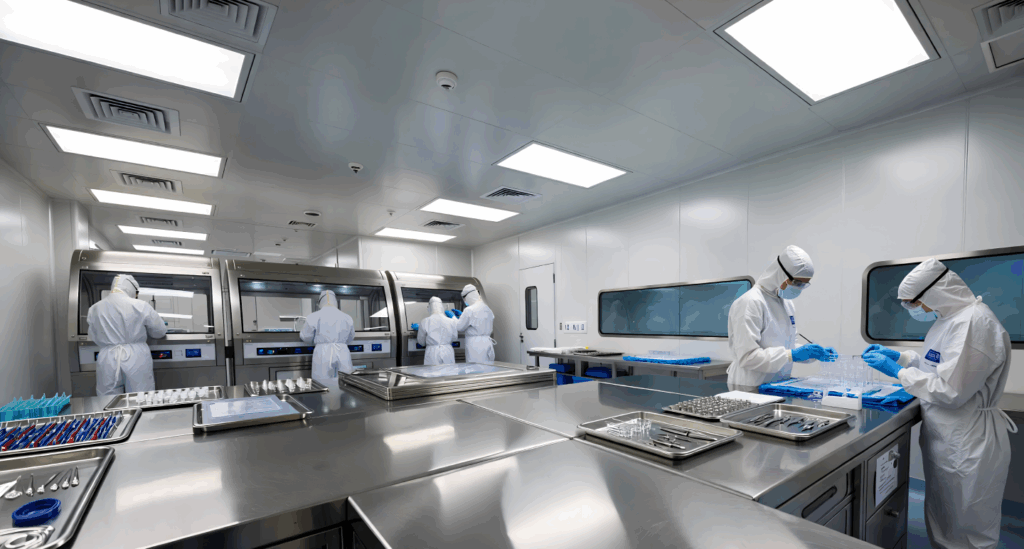
16 production Sites, 1.2M+ sq. ft. manufacturing space
16 production Sites, 1.2M+ sq. ft. manufacturing space
16 production Sites, 1.2M+ sq. ft. manufacturing space
16 production Sites, 1.2M+ sq. ft. manufacturing space
16 production Sites, 1.2M+ sq. ft. manufacturing space
16 production Sites, 1.2M+ sq. ft. manufacturing space
16 production Sites, 1.2M+ sq. ft. manufacturing space
How We Run Manufacturing Programs?
Transfer / NPI Readiness
Structured DFM alignment, documentation review, risk mapping, and production planning before release.
Validation & Process Qualification
IQ/OQ/PQ execution (where applicable), control plan development, and documented process validation.
Process Controls + Documentation Management
Controlled DMR/Device records, traceability architecture, change documentation discipline.
Change Control / Sustaining Engineering Interface
Structured engineering change management aligned to regulatory and quality requirements.
Ramp + Steady-State + Product Lifecycle Continuity
Capacity planning, yield stabilization, and long-term production governance.
Geo-Diversified Supply Chain & Resilience
Manufacturing operations across India, the U.S., and Europe support trade flexibility and production continuity.
This geo-diversified supply chain model strengthens production continuity, risk mitigation, and responsive fulfillment across global programs.
Supply Risk & Continuity
- Supplier qualification & audits
- Approved alternates and dual sourcing strategy
- Component obsolescence management
Traceability & Control
SAP-enabled real-time tracking
Lot-level traceability and controlled inventory practices
Logistics Execution
Global logistics coordination
Exception handling and expedited recovery pathways
Why Syrma Johari MedTech
Multi-site Manufacturing Footprint
A scalable, multi-location manufacturing model supports capacity, flexibility and continuity planning for global OEM supply chains.
Design-to-Manufacturing Transfer Discipline
Integrated engineering and production alignment reduce transfer risk.
Purpose-built for regulated MedTech & IVD
Manufacturing systems built specifically for regulated medical devices.
Multi-process manufacturing under one QMS
Metal, plastics, and PCBA capabilities under unified quality governance.
Stable Execution at Scale
Lean execution and structured supply chain coordination improve production stability.
Global Regulatory Alignment
Compliance across FDA, EU MDR, MDSAP, CDSCO, and other international frameworks.
Flexible Volume Scalability
Scale seamlessly from high-mix, low-volume builds to stable high-volume production.
Success Stories
Scaled Medical Device PCBA Production to Meet Increasing Market Demand
Enabled scalable, compliant PCBA manufacturing while improving device reliability, test throughput, and environmental resilience.
Precision Manufacturing Support for Advanced Endoscopy Systems
Delivered precision manufacturing, quality control, and process optimization to support high-performance endoscopic platforms.
Multi-Generation Redesign & Cost Optimization of a High-Speed IVD Homogenizer Platform
Executed multi-generation engineering and DFM optimization, achieving faster lysis, cost reduction, and global scale deployment.
Begin a Structured Manufacturing Discuss
From transfer evaluation to production scale-up, the right partner brings disciplined governance and operational stability. Syrma Johari MedTech collaborates with Medtech OEM teams to assess production strategy, validation planning, and lifecycle continuity — before execution begins.
Information Center
What are medical device contract manufacturing services?
Medical device contract manufacturing services involve outsourcing regulated production to a specialized manufacturer operating within ISO 13485–aligned quality systems. Services typically include mechanical manufacturing, PCB assembly, validation, packaging, labeling, and supply chain coordination.
How is Syrma Johari MedTech different from a typical contract manufacturer?
Syrma Johari MedTech operates exclusively in regulated MedTech manufacturing. Our design-aligned transfer processes, vertically integrated metal, plastics, and PCBA capabilities, and global regulatory compliance frameworks support controlled production continuity.
What types of medical devices do you manufacture?
We support Class I, II, and III medical devices across diagnostics, patient monitoring, drug delivery, critical care, rehabilitation, medical aesthetics, and surgical platforms.
Are your manufacturing operations globally compliant?
Yes. Manufacturing operates within ISO 13485 and ISO 27001 certified systems and complies with FDA 21 CFR Part 820, EU MDR/IVDR, MDSAP, Health Canada, CDSCO, and other applicable regulatory frameworks. Full traceability and risk-based documentation are maintained.
Do you offer cleanroom manufacturing and sterile packaging?
Yes. Our facilities include ISO Class 7 and Class 8 cleanrooms, controlled ESD environments, optics assembly rooms, and validated sterile and non-sterile packaging capabilities.
Can you support design transfer into production?
Yes. Structured design transfer includes DFM reviews, NPI planning, DMR finalization, and IQ/OQ/PQ validation to ensure stable production readiness.
How do you manage supply chain resilience?
Geo-diversified operations across India, the U.S., and Europe support trade flexibility and production continuity. Capabilities include supplier qualification, SAP-enabled inventory tracking, predictive risk monitoring, and obsolescence management.
How is intellectual property protected?
Intellectual property is safeguarded through structured MSAs and NDAs, ISO 27001–aligned information security controls, access governance systems, and controlled digital and physical environments.

Capabilities
- Design and Development
- Engineering
- Contract Manufacturing
- QARA Services
- Product Lifecycle Management
- Medical PCB Assembly
- Medical Plastics Manufacturing
Market Segments
- IVD & Laboratory Diagnostics
- Medical Aesthetics
- Rehabilitation and Physical Therapy
- Patient Monitoring
- Drug Delivery
- Critical Care
- Surgical and Interventional Care
- Point of Care
COMPANY
- About Us
- Leadership
- Certifications and Awards
- ESG and Sustainibility
LEGAL
- CSR Policy
- Privacy Policy
- Terms & Conditions
- Terms of Use
CONTACT US
- Contact us
- Careers
MADE IN INDIA FOR THE WORLD