Medical PCB Assembly
Services
ISO 13485 and IPC Class 3 compliant medical PCB assembly with unmatched precision and reliability.

Your Turnkey medical PCB Assembly Partner
Medical PCB assembly demands a level of precision and discipline that goes far beyond conventional electronics manufacturing. Even a minor deviation can compromise system performance and introduce unacceptable clinical risk.
With over 45 years of experience delivering PCB assemblies exclusively for the MedTech sector, we are trusted by global OEMs for our consistent focus on excellence. Our deep domain expertise and world-class manufacturing processes ensure patient safety, product quality, and traceability at every stage of production.
Manufacturing Scale Built
for MedTech
16
Manufacturing Sites Globally
35
High-Speed SMT Lines
5M+
PCBs Assembled Annually
100%
Exclusively MedTech
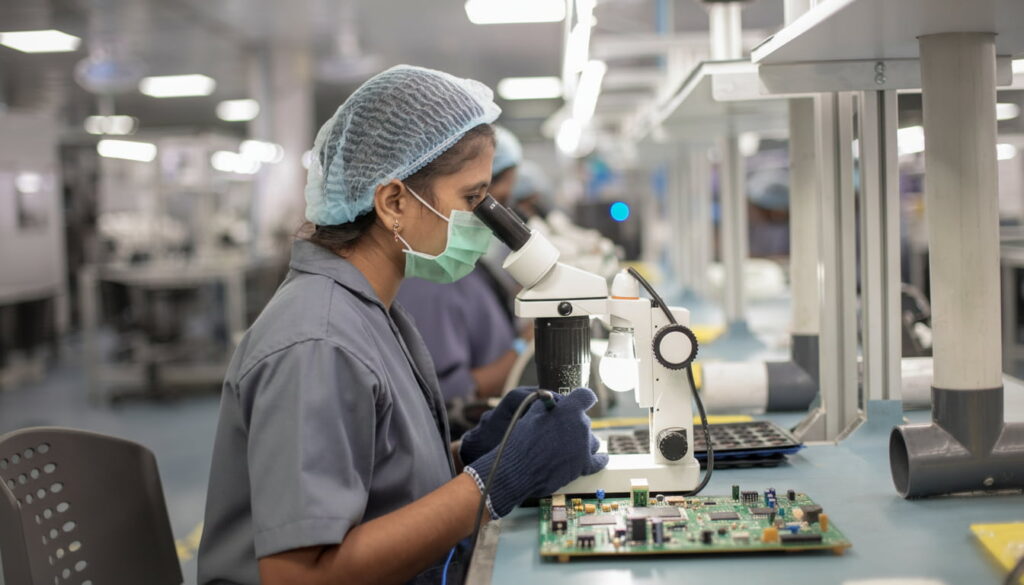
Our Comprehensive PCB Assembly Capabilities
We provide turnkey medical electronics manufacturing services under one roof, supporting prototyping, NPI, and full-scale production. Our capabilities span PCB design, fabrication, assembly, testing, packaging, and regulatory-compliant labeling.
PCB Assembly Technologies
- Surface Mount Technology (SMT)
- Through-Hole Technology (THT)
- Hybrid assembly (SMT + THT)
- Package support: BGA, μBGA, QFN, QFP, CSP, MELF
- Fine-pitch component placement
- Flip-chip assembly
- Chip-on-board (COB) assembly
- High-speed automated placement (up to 333,000 CPH)
Board Types & Advanced Technologies
- Rigid, flex, and rigid-flex PCBs
- Double-sided PCBs
- Multilayer PCBs (up to 32 layers)
- High-Density Interconnect (HDI) PCBs
- Complex RF microelectronics
- Mixed-signal and high-speed PCBs
- Wave soldering
- Selective soldering
Environmental Protection & Reliability
- Automated conformal coating (acrylic, urethane, silicone)
- Plasma coating
- Potting and encapsulation
Packaging & Labeling
- ESD safe packaging
- Labeling per GS1 standards
Ensuring Zero-Defect Assembly of Medical PCBs
We conform to strict quality standards that maximize first-pass yield and enable flawless performance of your medical devices. Each PCB assembly is built to spec through systematic in-line inspections, functional verification, and quality checks throughout the process.
Extensive Testing Protocols
DFM and DFA analysis
In-circuit testing (ICT)
Flying probe testing
Functional testing
Reliability testing
Customized PCB programming test
Custom Tooling & Scalable Fixtures
Modular jigs
Wave pallets
Rigorous Inspection Checkpoints & Real-Time Monitoring
Solder paste inspection (SPI)
3D automated optical inspection (AOI)
X-ray inspection
Solderability testing
Peel testing
Micro-sectioning analysis
Time-domain reflectometry (TDR)
Continuous Improvement
Lean manufacturing practices
Six Sigma methodologies
Kaizen culture
Ongoing employee training programs
High-Throughput PCBA Testing with Automated Test Fixtures
We bring deep in-house expertise in custom-developed, automated test jigs and fixtures to achieve high test accuracy and throughput for medical PCBAs.
In-house design, manufacturing, and validation of customized functional test fixtures
In-circuit test (ICT) fixtures with high-density bed-of-nails configurations and precisely aligned pogo pins for consistent contact
Mechanical, pneumatic, and customized automation modules supporting high pin-count and fine-pitch PCBAs
Advanced Facilities Powering High-Reliability PCB Assembly at SJML
PCB Loader
Auto fault alerts with precise, damage-free PCB handling
PCB Cleaner
ESD-safe surface preparation
Solder Paste Printer
Closed-loop SPI system with automated temperature and humidity control
Solder Paste Inspection (SPI)
Shadow-free, data-driven paste quality control
High-Speed Chip Mounter
Software-programmed, high-speed placement (180K CPH)
In-Line Inspection
Real-time defect detection
Reflow Oven
N2-enabled controlled thermal profiling
Coating Machine
Automated conformal coating with process consistency
Wave Soldering
Controlled through-hole soldering for reliable interconnects
Our Certifications


Success Stories
Cost-Effective, Scalable Manufacturing for a Life-Saving IVD Platform
Transitioned a complex digital microfluidics prototype into cost-efficient, high-volume regulatory-compliant production.
Scaled Medical Device PCBA Production to Meet Increasing Market Demand
Enabled scalable, compliant PCBA manufacturing while improving device reliability, test throughput, and environmental resilience.
Engineering Optimization and Manufacturing Support for Diagnostic Platforms
Strengthened manufacturing efficiency, regulatory readiness, and cost optimization for sustained diagnostic platform growth.
Speed Up Your Product from Line to Market
Fulfill your medical PCB assembly requirements and expedite time-to-market with our flexible and proven solutions.
Information Center
What types of medical devices do you support with PCB assembly?
We provide PCB assembly services for a wide range of medical devices across multiple risk classes. Our experience includes diagnostic equipment, patient monitoring systems, therapeutic and rehabilitation devices, medical aesthetic platforms, and surgical systems.
Can you support both,low-volume and full-scale production?
Yes. Our medical PCB assembly solutions are customized as per your volume needs. We help you scale efficiently from prototypes and pilot builds to mass production. Our teams participate early through DFM reviews, tooling development, and process validation to streamline production scale-up.
How do you maintain consistent quality across different production volumes?
We apply strict process control and inspection rigor across all volumes using in-line 3D AOI, in-circuit testing, functional testing, and X-ray inspection where required. Each production stage includes traceability and monitored checkpoints, allowing issues to be identified and addressed before they affect downstream processes.
Are your PCB assembly processes compliant with medical regulations?
Our PCB assembly processes follow global regulatory and environmental requirements applicable to medical device manufacturing. We operate within an ISO 13485–certified framework and conform to IPC-A-610 Class 3 standards, along with FDA 21 CFR Part 820 and relevant IEC requirements.
Do you provide Design for Manufacturability (DFM) support?
Yes. Our engineering teams engage early in the design phase to conduct DFM and DFA reviews. This approach helps reduce production risk and supports smoother transitions from development to manufacturing.
How do you support programs with changing volumes or product variants?
We manage changing volumes and product variants through flexible production planning, buffer strategies, and close coordination with customer teams. Agile work cells, digitally guided work instructions, and disciplined lean manufacturing practices support quick transitions between variants while maintaining throughput across high-mix, low-volume builds.

Capabilities
- Design and Development
- Engineering
- Contract Manufacturing
- QARA Services
- Product Lifecycle Management
- Medical PCB Assembly
- Medical Plastics Manufacturing
Market Segments
- IVD & Laboratory Diagnostics
- Medical Aesthetics
- Rehabilitation and Physical Therapy
- Patient Monitoring
- Drug Delivery
- Critical Care
- Surgical and Interventional Care
- Point of Care
COMPANY
- About Us
- Leadership
- Certifications and Awards
- ESG and Sustainibility
LEGAL
- CSR Policy
- Privacy Policy
- Terms & Conditions
- Terms of Use
CONTACT US
- Contact us
- Careers
MADE IN INDIA FOR THE WORLD