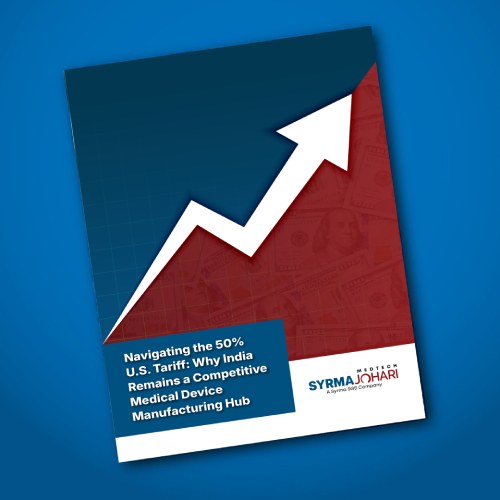
Navigating the 50% U.S. Tariff: Why India Remains a Strategic MedTech Manufacturing Partner
A comprehensive knowledge guide for MedTech leaders assessing tariff impact and long-term supply chain resilience.Download the Report
Impact of the 50% U.S. Tariff on Indian MedTech Imports
In August 2025, the United States imposed a 50% tariff on Indian medical device imports, reshaping global MedTech supply chains. For MedTech leaders, this market intelligence report offers strategic guidance on navigating tariff-driven cost pressures while leveraging India’s unique advantages, including low manufacturing wages, regulatory compliance, and supply chain resilience.
Rather than reactive advice, the report provides a forward-looking framework to optimize sourcing strategies, evaluate landed costs, and build resilient global partnerships with India as a trusted MedTech manufacturing hub.
Key Insights
- U.S. tariffs on Indian medical devices surged from 26% to 50% in August 2025, the highest among major U.S. trading partners. Other countries impacted by higher tariffs include China (34% increased to 115%) and Canada (25% increased to 35%).
- India’s resilience is proven: In 2019, despite losing GSP benefits, it maintained exports in top sectors; in 2018, when steel and aluminum tariffs hit, it redirected exports to Southeast Asia and the EU, regaining net exporter status by FY 2019–20; and during the 1962 trade freeze with China, it pivoted exports to Western and Soviet markets.
- Medical device companies should re-run cost analyses that factor in the 50% duty. Finance and sourcing teams must be well-versed in these tariff-adjusted calculations, and many consultants recommend scenario modeling (e.g., “What if India’s tariff remains at 50% for five years?”) to guide long-term supply strategies.
- India’s unique cost arbitrage stems from its $12 billion MedTech industry, growing at ~15% annually. This advantage is reinforced by lower labor and overhead costs, a skilled workforce, mature quality systems, and an integrated ecosystem to support medical device manufacturing. Even under a 50% U.S. tariff, Indian firms continue to deliver landed-cost advantages across a wide range of medical devices.
- Our strategic lens for U.S. medical device companies encompasses Tariff-Adjusted Cost Modeling, strict adherence to FDA/CE/ISO standards, quality-first approach culture, support for co-innovation and new product development, and a diversified supply strategy.
Who Should Read This Report
- U.S.-based Medical Device Manufacturers
- MedTech CEOs & COOs
- Investors in Healthcare Manufacturing and MedTech Supply Chains
- Global Supply Chain Heads
- MedTech Sourcing and Procurement Leaders
- Strategic Planning Teams
- Regulatory and Quality Affairs Teams
Syrma Johari MedTech is a strategic Indian medical device manufacturing partner.
For MedTech leaders, the viable approach is not disengagement but recalibration. When one source faces a tariff or disruption, others can seamlessly compensate.
Syrma Johari MedTech’s global footprint provides MedTech companies a strategic edge. With 100% export-oriented operations, our diversified infrastructure includes a design center in Europe, manufacturing facilities in Germany, and a footprint in the U.S. This geographic distribution of operations enables MedTech companies to navigate trade complexities while ensuring long-term resilience.