Given the rapid advancements in technology and evolving clinical needs, the medical device landscape is shifting fast and so are manufacturing workflows and regulatory overheads. For high-risk medical devices, companies increasingly rely on contract manufacturing partners to manage operations that are too complex or costly to run in-house. While cost is a sizeable factor, stronger motivations are access to scale, specialized capabilities, and faster execution. That said, one principle remains unchanged: production may be outsourced, but the responsibility for regulatory compliance always rests with the Original Equipment Manufacturer (OEM).
For quality assurance and regulatory affairs (QARA) leaders, managing global supply chains now requires closer and continuous monitoring of external partners and clearer evidence that every site meets regulatory expectations. Launching in multiple markets further increases this compliance overhead.
Every regulator expects end-to-end oversight, and non-compliance costs money, time and credibility. Yet, many MedTech leaders make the error of approaching contract manufacturing as a procurement activity, rather than a regulatory responsibility. On the contrary, they must implement an outsourcing model built for regulatory and market success, and this article outlines a practical framework to achieve this.
Factors Driving Adoption of Contract Manufacturing in MedTech:
- Scalability and Cost Efficiency: Global CMOs can deliver medical devices at scale, reducing CAPEX and lead times.
- Specialized Capabilities: From cleanroom molding to sterilization, CMOs often bring niche technical expertise for complex medical devices.
- Post-COVID Supply Chain Reset: The coronavirus disease 2019 (COVID-19) pandemic exposed internal bottlenecks and sparked a shift toward more flexible, diversified manufacturing ecosystems.
Driven by innovation in Class II / III devices and increased outsourcing of specialized processes, the global medical device contract manufacturing market is growing rapidly. Currently expanding at a CAGR of 10.9%, the market is expected to reach USD 140.8 billion by 2030.
To stay competitive, medical device companies must embrace this trend without compromising on regulatory compliance.
Class I, II, III Devices: How Do QARA Responsibilities Change When You Outsource?
Class-I Devices: Low Risk → Basic SupervisionClass-I devices (e.g., bandages, manual instruments) are low risk and typically subject to general controls. QARA focus: Ensure contract manufacturers comply with foundational quality requirements like 21 CFR Part 820 (U.S.) or ISO 13485 (EU). Most are exempt from 510(k) pre-market notification in the U.S., but EU Medical Device Regulation (MDR) now requires CE marking and quality management system (QMS) compliance for some low-risk devices as well. Formalize responsibilities through supplier agreements and periodic quality audits.
|
Class-II Devices: Moderate Risk → Stronger ControlsDevices like infusion pumps or diagnostic tools fall under Class II and require more regulatory documentation. QARA focus: Support 510(k) submissions (U.S.) and technical documentation (EU). Outsourced partners must follow design controls and verification protocols, especially if they’re involved in development. Implement clear traceability for validation and integrate external partners into risk and design reviews.
|
Class-III Devices: High Risk → Intensive ScrutinyThese include implants and life-supporting devices, requiring relevant clinical evidence and post-market monitoring. QARA focus: Maintain comprehensive design history, clinical data, and risk management files. Manufacturers must ensure outsourced partners are always prepared for regulatory audits and aligned on vigilance, unique device identification (UDI), and MDR / FDA compliance. Conduct frequent audits and embed contract manufacturers into your QMS and post-market surveillance (PMS) systems.
|
OEM vs. Contract Manufacturer: Defining Quality and Regulatory Ownership
Original equipment manufacturers (OEMs) are always the legal manufacturers. This means:
- You’re liable for the safety, efficacy, and compliance of your device.
- Regulatory bodies will hold you accountable for quality failures, even if they happen at your CMO.
Contract manufacturers, on the other hand:
- Must be ISO 13485:2016 certified to comply with regulatory expectations across most regions.
- Must maintain validated processes, keep the Device History Record (DHR) up-to-date, and stay prepared for audits at all times.
- Quality agreements must clearly assign responsibility for:
- Handling complaints
- Escalating issues to regulators
- Managing change control, maintaining risk files, completing CAPA activities, and ensuring labelling compliance
Critical QARA Risks in Outsourced Manufacturing
| Risk Area | Impact |
| Regulatory non-compliance | Delays, warning letters, denied approvals |
| Inadequate supplier oversight | Form 483s, consent decrees |
| Incomplete documentation | Delays in Notified Body / FDA / National Medical Products Administration (NMPA) reviews |
| Siloed CAPA and change control | Quality drift, device recalls |
| Missed clinical planning | Duplicate studies, increased cost and time |
| Language / localization gaps | Submission rejections or market delays |
| Intellectual property (IP) exposure | Risk of competitive leakage |
Real-World Case Study: FDA Warning Letter Triggered by Lapses in Supplier Control
In September 2025, a U.S. medical-device company received an FDA Warning Letter after inspectors found major gaps in its supervision of a contract design manufacturer. The supplier could not produce required design documentation, had introduced unapproved changes to the device, and lacked evidence of proper validation. FDA concluded that the OEM had not exercised adequate purchasing controls or supplier monitoring.
The company was required to stop distribution of the affected devices, rebuild the design records with its supplier, and revise its supplier-control processes.
Lesson: Even when the lapse occurs at a third-party site, the OEM carries full responsibility. Weak supplier controls can lead to halted distribution, remediation costs, and regulatory scrutiny.
Region-Specific Regulatory Expectations from Medical Device Companies and Their CMOs
Outsourcing doesn’t relieve you from regulatory scrutiny. It comes with complete accountability despite shared execution. Regulatory authorities in major markets expect OEMs to enforce supplier controls, submit region-specific documentation, and validate that every contract site is compliant.
Key considerations for you and your CMO across major markets include:
United States – FDA
- Framework: Quality System Regulation (21 CFR Part 820).
- Expectation: OEM must validate and monitor all outsourced manufacturing per 21 CFR 820.50 (purchasing controls).
- Risk Note: FDA warning letters frequently cite inadequate supplier supervision as a top violation.
European Union – EU MDR
- Framework: Medical Device Regulation (EU) 2017/745.
- Expectation: OEM retains the responsibility even when outsourcing. CMOs must be identified as “critical subcontractors”.
- Key Risk: Unannounced audits are permitted. OEMs must demonstrate control over the entire supply chain.
- Documentation: Quality Agreements, PMS plans, and technical documentation must reflect subcontractor controls.
United Kingdom – Medicines and Healthcare products Regulatory Agency (MHRA)
- Framework: Medical Devices Regulations 2002 (UK MDR 2002), as amended in 2025.
- Expectation: OEMs outside the UK must appoint a UK Responsible Person (UKRP). CMO oversight must be documented.
- Coming Change: Expect a gradual shift to UKCA-specific submission requirements, while CE-marked medical devices remain accepted in Great Britain under extended transitions until 30 June 2030 (depending on device type and certification status).
India – Central Drugs Standard Control Organization (CDSCO)
- Framework: Medical Device Rules (MDR), 2017.
- Expectation: All device classes (A–D) require registration or licensing. OEM must file the Plant Master File (PMF) and the Device Master File (DMF).
- Representation: Foreign OEMs must appoint an Indian Authorized Agent (IAA).
- Inspection Focus: CMO licensing, QMS verification, and product-specific testing are common CDSCO checkpoints.
Japan – Pharmaceuticals and Medical Devices Agency (PMDA)
- Framework: Pharmaceuticals and Medical Devices Act (PMD Act) and QMS Ordinance No. 169.
- Expectation: Class II–IV devices require pre-market approval (Shonin) and must be manufactured by a foreign manufacturer establishment (FME).
- Representation: Foreign OEMs must appoint a Marketing Authorization Holder (MAH).
- Documentation: Japanese Industrial Standards (JIS) compliance, local test data, and Japanese-language submissions are mandatory.
Australia – Therapeutic Goods Administration (TGA)
- Framework: Therapeutic Goods (Medical Devices) Regulations (TGA) 2002.
- Expectation: OEMs must submit an Australian Register of Therapeutic Goods (ARTG) application with proof of QMS and product conformity.
- Shortcut: TGA recognizes CE marking and Medical Device Single Audit Program (MDSAP) audits to streamline conformity assessment.
- Risk Note: TGA often verifies QMS robustness and documentation traceability for high-risk devices.
Key Takeaway
Regulators in every region look for clear proof that the manufacturer has control over its processes and suppliers. They also check whether the organization can handle audits and meet the specific requirements of each market. Your QMS needs to support these expectations across regions, and your contract manufacturer must be prepared for inspections at any time.
QARA-Led Partnerships for Risk-Smart and Compliant Manufacturing
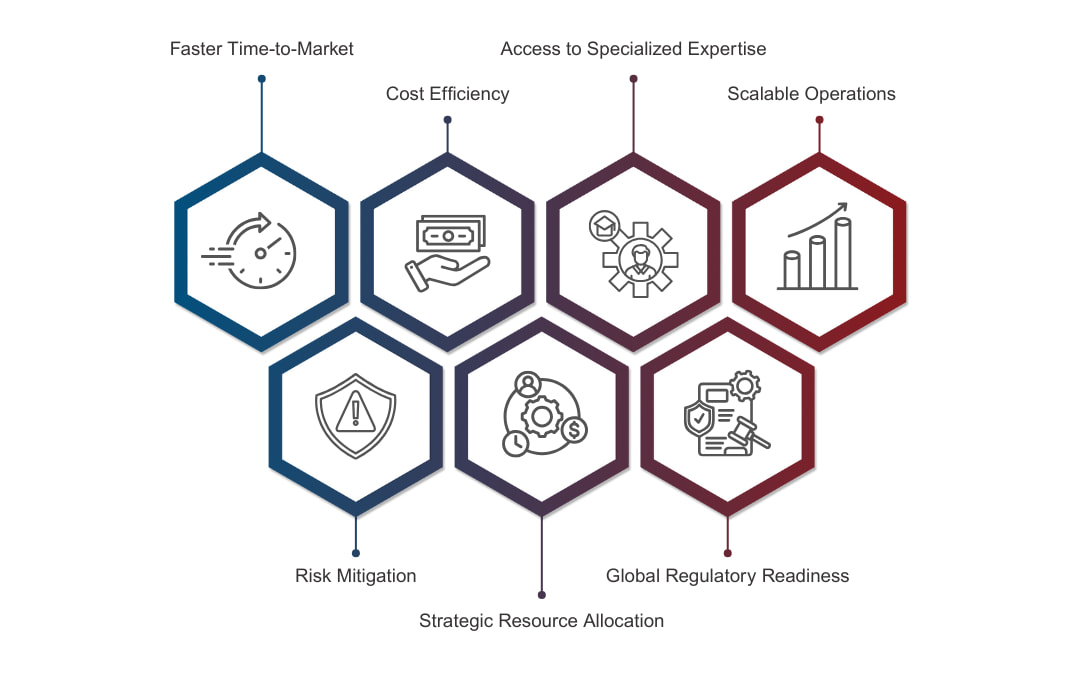
Today, top medical device companies choose QARA-focused CMOs and factor in regulatory compliance into the partnership from day one.
The Advantages of Choosing QARA-Centric CMOs:
Best Practices for Quality and Regulatory Governance in Outsourced Manufacturing
- Include MDSAP criteria in audits when applicable to the target markets.
- Schedule Joint Quality Business Reviews (QBRs).
- Demand process validation reports, in addition to quality dashboards.
- Confirm that the CMO can handle unplanned inspections, recalls, or field investigations.
- Review documentation at set intervals and check traceability routinely.
Syrma Johari MedTech: A CMO Engineered for Global Regulatory Compliance
When you work with Syrma Johari MedTech, you gain a manufacturing partner that understands the regulatory demands of global markets and supports the quality and documentation requirements your team must uphold.
Our operational strengths designed for global compliance:
✓ Globally Compliant Quality Management System (QMS)
We design and manufacture medical devices in ISO 13485:2016- certified and US FDA-audited and approved facilities, compliant with global QMS standards including ISO 9001, IPC-A-610, RoHS, REACH, MDSAP, FDA 21 CFR Part 820, EU MDR, Health Canada, UK MHRA, and CDSCO.
✓ ISO 14971:2019-Based Risk Management
We apply ISO 14971:2019 principles across the product lifecycle, document risks systematically, and implement controls based on clear evidence.
✓ Lean Manufacturing and Continuous Improvement
We apply Lean and Six Sigma methods, run Kaizen cycles, issue engineering change requests (ECRs) when improvements are needed, and close gaps through CAPA, root-cause analysis (RCA), and statistical process analysis.
✓ Real-Time Traceability
We utilize an SAP-based ERP for real-time inventory tracking, component-level barcoding, and UDI data integration. It also supports full traceability across the Device Master Record (DMR), Design History File (DHF), and Device History Record (DHR), along with CAPA workflows, providing end-to-end visibility across manufacturing.
✓Comprehensive Technical Documentation
We prepare and maintain DHF, DHR, DMR, Technical Construction Files (TCF), and validation records, and structure all documentation to meet region-specific regulatory requirements.
✓ Multi-Stage Quality Control
We conduct incoming inspection, perform in-process quality checks (IPQA), and complete final quality control before release, ensuring full traceability from components to finished devices.
✓ Supplier Qualification and Ongoing Control
We qualify suppliers through audits and capability assessments, monitor performance using Supplier Corrective Action Requests (SCARs), run requalification cycles, and apply Green Channel access for consistently high-performing vendors. Our team inspects materials on arrival and maintains strict documentation for every lot.
✓ Verification and Validation (V&V)
We carry out full Verification and Validation (V&V) for equipment, processes, and products, ensuring that each step meets defined performance and safety requirements.
✓ Collaborative QARA Governance
We actively participate in design reviews, post-market planning, and risk discussions to ensure smooth coordination with your internal teams.
A Regulatory-First Approach to Medical Device Outsourcing
With increasing regulatory pressure, medical device companies need CMOs that operate with reliable quality systems, validated processes, and exhaustive regulatory documentation. A regulatory-first outsourcing approach for manufacturing ensures consistent performance across regions and supports uninterrupted market access.
At Syrma Johari MedTech, we make sure your devices are designed for compliance, engineered for scale, and equipped to disrupt the market.